Why Carnations?
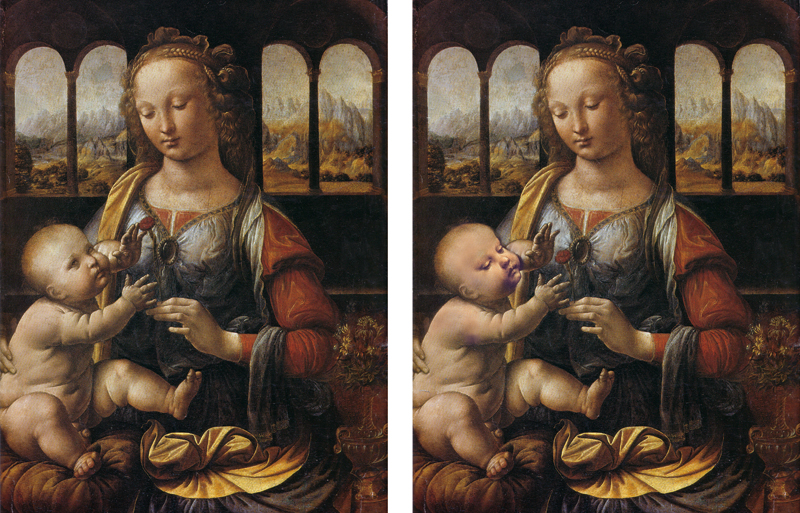
The gaze of the infant Jesus
The image on the left is the original Madonna with a Carnation, while the image on the right has been modified to show the gaze of the infant Jesus and the position of the carnation.
Comparing these two paintings, it is immediately clear which was the original composition. The composition on the right, where everything is gathered near the center of the screen, and the composition on the left, where everything is scattered, have a very different level of completion as a painting.
The question is why such modifications to the screen were necessary, and I believe the fundamental cause of these modifications was Leonardo's additional depiction of the brooch on her chest. I think the additional steps were as follows:
1. The flower held by the Virgin Mary was stretching straight up.
2. Leonardo added the brooch in place of the flower.
3. The flower was moved to a position where it was not covered by the brooch.
4. The direction of the infant Jesus' gaze was redrawn in the direction of the flower.
When these modifications were made and the position of the third flower was moved so that it would not overlap the brooch, it became necessary to paint a flower with a long stem, and as a result, carnations were painted on the screen, which is probably why "Madonna of the Carnation" was born.
Originally, a different flower with a shorter stem was probably painted in this painting.
|
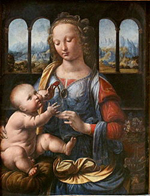
Madonna of the CarnationOil and tempera on poplar, 62.3 x 48.5 cm Alte Pinakothek
In particular, the head of the Madonna is clearly related to the drawing "Study for the Head of a Woman" by Verrocchio, which is owned by the British Museum. The facial contours, facial features, and hairstyle are almost the same. The Madonna of the Carnation is so similar that it would not feel strange to say that it was painted from Verrocchio's "Study for the Head of a Woman." This "Madonna of the Carnation" is probably a collaborative work between Verrocchio and Leonardo. However, I find it quite difficult to determine which parts were painted by Verrocchio and which parts by Leonardo. First, to start with the safe points, the background, including the landscape, is undoubtedly Leonardo. And the vase and flowers could not have been any other than Leonardo. The brooch on the Virgin Mary's chest is also undoubtedly Leonardo. And I feel that the blue costume of the Virgin Mary, which is a set with this brooch, is also likely to have been painted by Leonardo. The reason is that the design of this blue costume has a slightly open chest, which is not suitable for the Virgin Mary's costume. It is an absolute rule that the costume of the Virgin Mary in this era is always depicted with a tightly closed chest. It is unthinkable for the Virgin Mary to have an open chest. And in contrast to this blue costume, the Virgin Mary's red costume is depicted as a traditional costume with a tightly closed chest. When this "Virgin of the Carnation" was first painted, it is likely that the whole body, from the chest to the waist, was painted in red. This is because in this era, a red costume with a blue cloak was an absolute rule for the Virgin Mary. As you can see, it is almost certain that Leonardo painted the blue costume, but the question is who painted the Virgin Mary. The most likely possibility is that Verrocchio started the painting and Leonardo finished it. Since the Virgin's face has been repainted with oil paint, there is no doubt that Leonardo finished it. However, I feel that it is a very difficult question to determine who started the painting. I think that Verrocchio was the one who started the painting. The reason is the depiction of the Virgin Mary's neck and shoulders. Leonardo rarely painted such long, independent necks. In Leonardo's case, the shoulders are depicted in a round, arched shape, and are also characterized by being painted high up. If the depiction from the neck to the shoulders is by Verrocchio, then it would naturally be Verrocchio who painted the entire head, including the face. Next comes the question of the infant Jesus. This is also a difficult part to judge, but I believe that Leonardo painted the head of the infant Jesus. The reason is that the outline of the head shows almost the same characteristics as the infant Jesus in the Madonna of Benois. Furthermore, the head of Jesus has numerous wrinkles, just like the head of Mary. These wrinkles occur when painting over a wet drawing. This shows that the person who painted these layers was not yet familiar with the basics of oil painting. In other words, it was Leonardo who added to this part. The depiction of the infant Jesus' hands and feet also shows relatively similar characteristics to the infant Jesus in the Madonna of Benois, so it is safe to say that it is generally a depiction by Leonardo. However, the overall proportions seem to be somewhat elongated, with a slightly longer torso, which is a concern, as it is different from the proportions of the infant Jesus in the Madonna of Benois. Perhaps the overall outline is Verrocchio, and the detailed depiction is Leonardo.
Alte Pinakothek 80333 München
|


leonardoresearch.jp